Cutaneous squamous cell carcinoma (SCC)
SCC ranges from a local tumour with a high likelihood of cure to a higher-risk disease that requires broader staging and multidisciplinary planning.
How it may appear
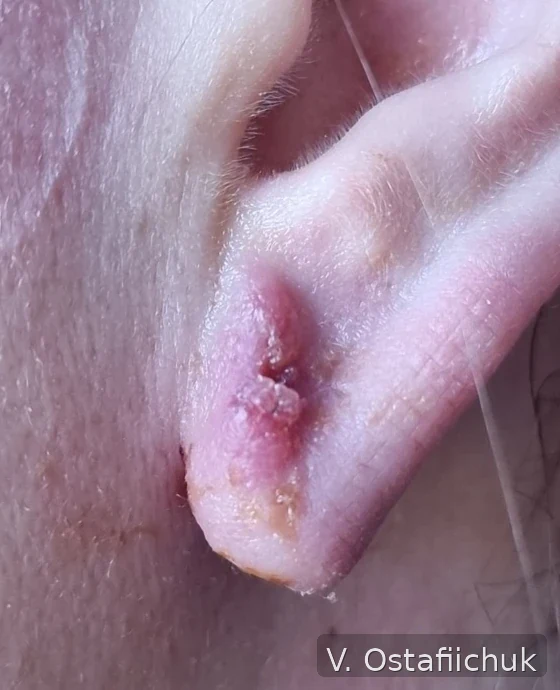
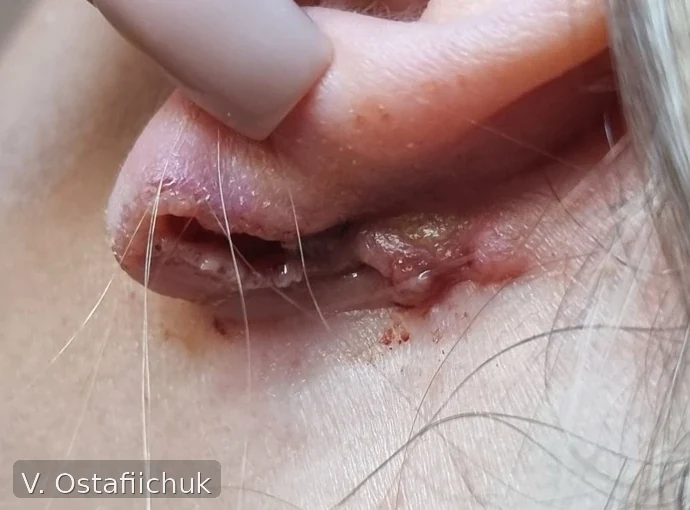
A persistent scaly or crusted area, a nodule, a non-healing ulcer, a bleeding lesion or rapid change in a pre-existing skin abnormality. Appearance alone cannot establish the diagnosis.
Why biopsy matters
Histology confirms SCC and reports features that influence risk, including differentiation, depth, perineural invasion and other characteristics. The biopsy method is selected according to size and site.
Higher-risk features
- larger size or deeper invasion;
- ear, lip or another complex anatomical site;
- recurrence, indistinct borders or rapid growth;
- immunosuppression or neurological symptoms;
- adverse pathological features.
AJCC 8 for cutaneous carcinoma of the head and neck
This AJCC 8 system applies to cutaneous squamous cell and basal cell carcinoma of the head and neck; it is not a universal staging system for every skin site. Eyelid carcinoma has a separate AJCC 8 chapter and TNM system.
| Stage | TNM / grade | What it means |
|---|---|---|
| Tis | Tis | Carcinoma in situ. |
| T1 | T1 | Tumour ≤2 cm. |
| T2 | T2 | Tumour >2-4 cm. |
| T3 | T3 | Tumour >4 cm, or minor bone erosion, deep invasion or defined perineural invasion. |
| T4a / T4b | T4a / T4b | T4a is gross cortical bone or marrow invasion; T4b is skull-base or skull-base foramen invasion. |
| N0 / N1 | N0 / N1 | N0: no regional nodal metastasis. N1: one ipsilateral node ≤3 cm without extranodal extension. |
| N2 / N3 | N2 / N3 | N2 covers specified single or multiple nodes up to 6 cm; N3 is a node >6 cm or clinically/pathologically significant extranodal extension. |
| M0 / M1 | M0 / M1 | M0: no distant metastasis; M1: distant metastasis. |
| 0 | Tis N0 M0 | Carcinoma in situ. |
| I | T1 N0 M0 | Tumour ≤2 cm without nodal or distant metastases. |
| II | T2 N0 M0 | Tumour >2-4 cm without nodal or distant metastases. |
| III | T1-T2 N1 M0; or T3 N0-N1 M0 | T3 without advanced nodal disease, or a smaller tumour with one small ipsilateral node and no extranodal extension. |
| IV | T1-T3 N2 M0; or T4 any N M0; or any T N3 M0; or any T/N M1 | More extensive nodal disease, bone/skull-base invasion or distant metastasis. |
Sources: AJCC Current Staging System 2026 - Cutaneous Carcinoma of the Head and Neck and Eyelid Carcinoma, 8th edition; NCI Skin Cancer Treatment PDQ.
Treatment
Surgical removal with margin control is the main treatment for most operable SCCs. High-risk disease may require regional node assessment, imaging, radiotherapy or systemic treatment within a multidisciplinary plan.
Reconstruction
On the face, ear and other functional sites, closure is planned alongside excision but without compromising tumour control.
Clinical images from the author's archive, published with confirmed consent. They are not intended for self-diagnosis.
This educational material does not replace clinical examination, a complete pathology report or an individual treatment plan.